Hushwell • Health Blog, Tinnitus Special Edition
March 12, 2026
How Constant Auditory Fatigue Disrupts Your Natural Balance and Sound Experience
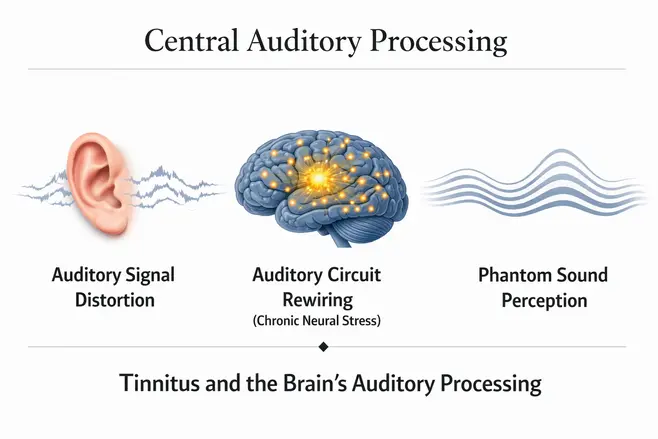
Emerging research suggests that persistent ear ringing may stem from auditory stress interfering with the brain’s natural neural balance — a subtle shift that can quietly reshape how sound is processed and experienced.
Drawing on clinical insights from the University of Texas and NASA, researchers are beginning to explore how restoring neural balance may help the auditory system recover clarity and stability over time.
Supporting your auditory system — A natural daily path to neural balance
Tinnitus is a biological response to environmental adaptation. To achieve lasting stability, the focus must shift from temporary suppression to supporting the natural pathways that regulate sound perception.
Discover how to keep enjoying live music and the rhythm of your daily routine while protecting your auditory health — and explore the natural physiological pathways that support lasting auditory balance.
The clinical perspective on "Auditory Processing" and "Hearing Balance"
Clinical observations referenced by institutions such as the University of Texas and research initiatives connected to NASA point to the idea that when auditory signals become inconsistent, the brain may adjust its internal processing to maintain perception — highlighting the role of the auditory cortex in organizing and stabilizing sound signals.
The breakthrough lies in supporting this signaling through targeted, natural rebalancing — a non-invasive strategy manageable within your daily personal health routine.
Sustainable stability — Supporting long-term neural health
By optimizing the environment for healthy neural communication, it is possible to reduce over-amplification and restore quality of life. This is evidence-based stability, implemented at home.
Auditory stability is the essential requirement for peak performance and wellbeing.
From clinical insights to daily clarity — see how understanding these concepts has reshaped our readers’ journeys
Disclaimer:
These insights point toward supporting the auditory cortex through natural rebalancing. Experiences shared reflect individual perspectives and are not intended as medical claims.
Thane R., 49
Florida
Commercial Real Estate Consultant
📧 Email testimonial • Submitted February, 12 2026
"I didn't realize how much energy the noise consumed. Gaining a clear perspective on the science brought immediate lightness. Understanding the sound was key to regaining my focus."
Aris M., 56
Texas
Healthcare Administrator
✍️ Written testimonial • Submitted February, 28 2026
"The educational framework changed how I listen to my own experience. Learning about neural regulation gave me hope that this doesn't have to define my future."
Lachlan L., 63
Connecticut
Former Mechanical Engineer
✍️ Written testimonial • Submitted February,16 2026
"I assumed this strain was just aging. Finally understanding how my hearing system works, I've regained a sense of clarity that I thought was gone forever."
◀ PreviousNext ▶
Bringing the clinical perspective into auditory balance and daily clarity
Explore the method in greater detail through a clear path toward auditory wellness.
Common Questions
Is this a medical treatment or a cure for tinnitus?
+
No. This is not a medical treatment or a cure. This is an educational explanation of how prolonged auditory strain affects the brain and how high-demand environments address neural stability. It introduces a brain-based regulation framework, not a medical intervention.
Does this involve medication or any kind of device?
+
No. There is no medication, device, or external equipment involved.
The approach centers on guided neural regulation designed to help the brain exit constant alert mode, rather than relying on tools or masking strategies.
So what exactly is being presented here?
+
This content introduces a structured neural stabilization, informed by aviation and performance research, that explains how the brain can relearn stable sound processing after prolonged strain.
Full details and supporting explanations are presented clearly in the complete presentation.
How is this different from what most people try for tinnitus?
+
Most approaches focus on the ear or on managing sound itself. This perspective focuses on how the brain responds to ongoing auditory strain, and how restoring regulation may change that response over time.
Is this approach safe to explore at home?
+
The material introduces non-invasive, at-home neural support concepts drawn from research used in high-demand environments. It is presented for understanding and awareness, allowing individuals to learn how neural regulation is approached outside of clinical settings. Considerations around personal health and next steps are addressed in the full explanation.